

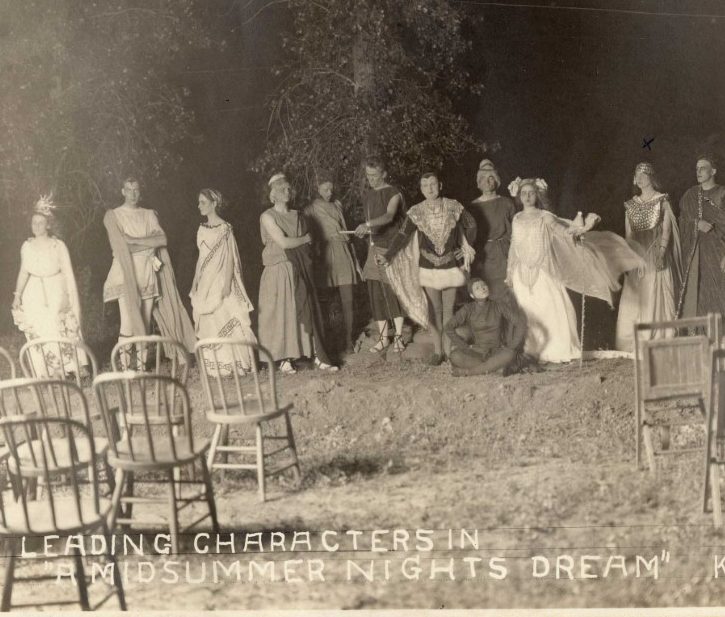
On Sunday, the ninth of June, 1912, one day after Kinsley’s A Midsummer Night’s Dream was slated to close, an extensive article celebrating Charlie and Gilmor’s historic production appeared in the Kansas City Star.
The paper produced nearly half a page, covered seven columns, and contained four images–quite a spread for a small town three hundred miles from the metro paper. Not disappointed, the reporter sent all those miles by train to investigate a potentially amateur-quality amateur Shakespeare production was smitten. The writer beamed with praise, describing the group they encountered on their trip in the best of terms:
Very often amateur performances are of interest only to the fathers and mothers of the performers, and from a dramatic standpoint they are likely to be very, very tragic. But it wasn’t that way with Kinsley’s outdoor play. There was a dash and a spirit about the performance that would have put many a professional effort to the blush.
Gilmor Brown’s experience from working with the outdoor Shakespeare expert, Ben Greet, certainly impacted the final product, which the article’s author pointed out. The reporter also covered details of the play’s actions thoroughly but, most importantly, included the details of the community’s reactions. It was not just for people “in town,” but for the whole community. Farmers came in from the countryside with their animal teams and machinery, and guests came from hundreds of miles away.
Everybody believed in the play and wanted to see it succeed, and their wishes in that regard were amply gratified. The big outdoor theater was crowded every night. People went away and came again…The whole community seemed to feel that it was not just “a play,” but their play.
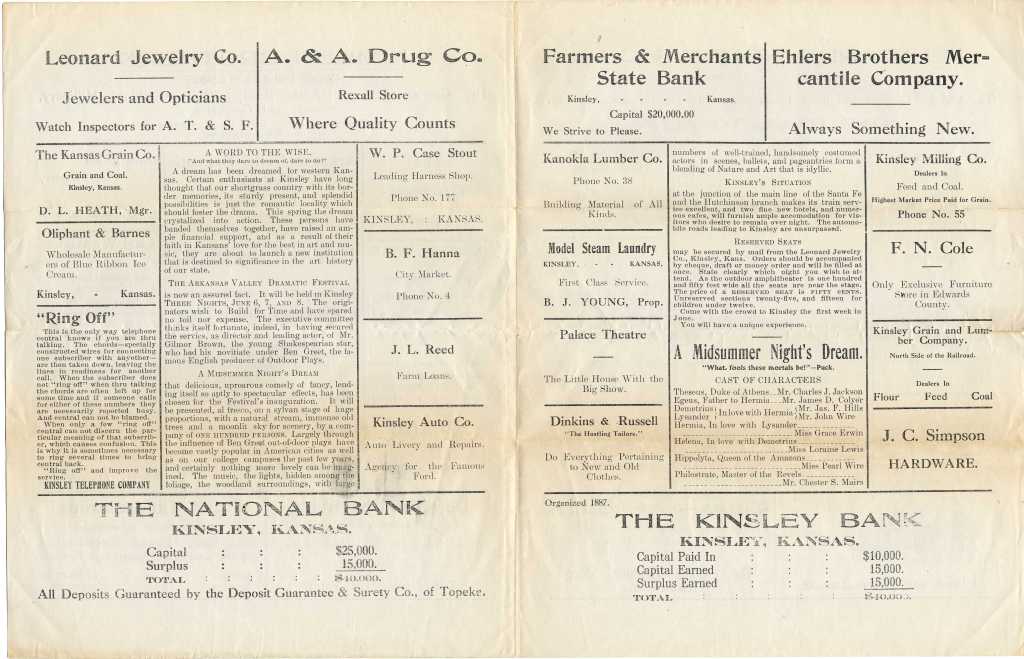
The play had done what it was designed to do: create community pride and raise money for a local cause while bringing people closer together.
This rousing story closed with an anecdote that the reporter crafted for effect, which tells of a boy visiting from another town:
“What are they doing down there in the grove?” he asked the youngster who was his host.
“They’re getting ready to have A Midsummer Night’s Dream,” the Kinsley boy told him.
“Who dreamed it?” the out-of-town boy wanted to know.
“Charlie Edwards dreamed it,” his host told him.
“Naw, he didn’t either,” spoke up another Kinsley youth, “a fellow named Gilmor Brown, he dreamed it.”
Confessing that there “was much truth” in both responses, the author described a vision that did not end with this year’s production. Instead, Charlie and Gilmor planned for “an institution” where they would give a festival-like Shakespeare play every summer. The Star’s piece closed with, “there seems to be no reason why that dream should not come true.”
This article, entitled “Fairies in the Short Grass,” sounded a fanfare for Charlie, Gilmor, and Kinsley’s success across the region. The newspapers had chronicled the romantic and idealistic reveries of two men who captured the imagination of countless Kansans. They had inspired others to envision a better and more cohesive future. Through Shakespeare’s work, they expressed feelings they otherwise could not articulate, and they used his cultural legacy as both a shield and a sword.
A day after the Star published the celebratory piece, the production closed. However, when the one hundred players took the grassy stage for a final time as the now famous fairies, they already had the opportunity to read their celebrated accomplishments in real-time. Nearly two thousand people attended the three performances, five hundred more people than resided in the small prairie town. Charlie, Gilmor, and ninety-eight others took their bows as an awestruck crowd cheered for more. But luckily for the adoring audience, this was just the beginning.
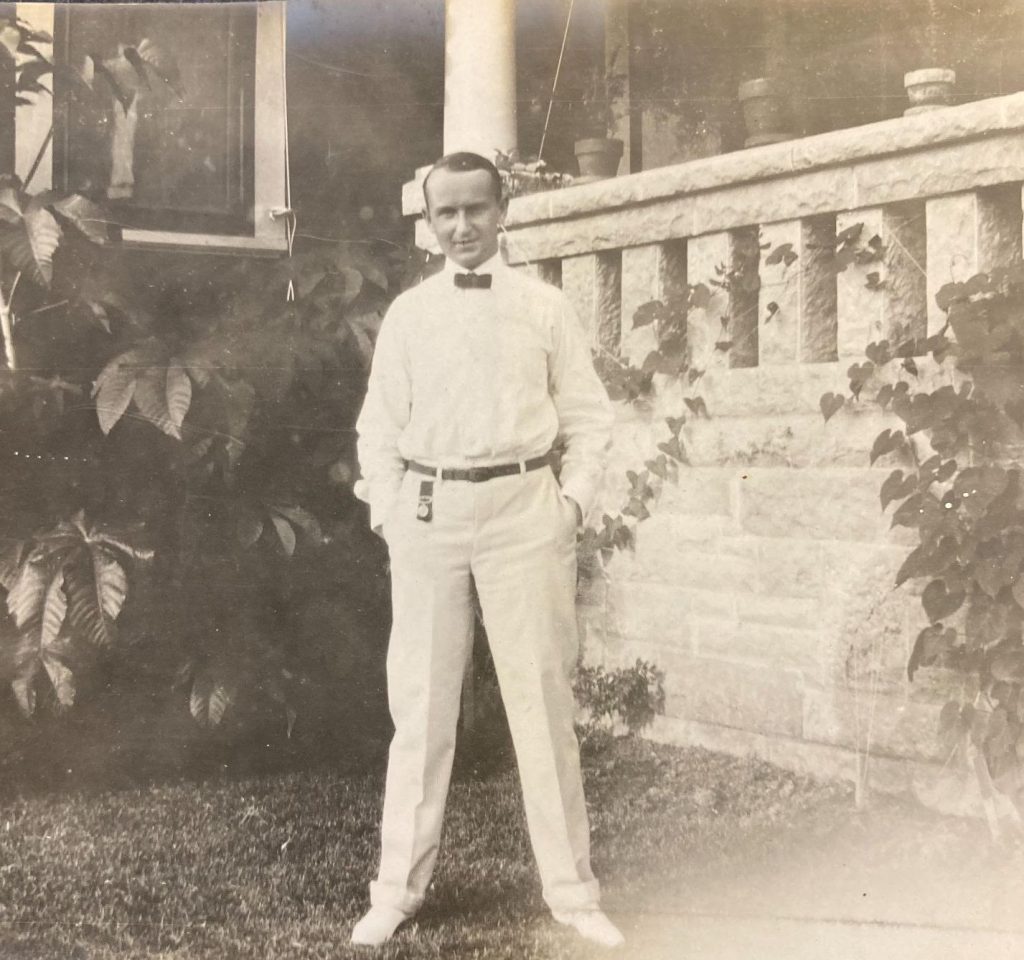
Charlie Edwards stands in front of the Edwards Mansion in Kinsley, Kansas, 1905. Courtesy of the Edwards County Historical Society.
Charlie would participate in over seventy-five productions during his life and would lead some of the largest casts of Shakespeare’s Midsummer Night’s Dream, As You Like It, Twelfth Night, and The Tempest ever assembled. He would share a stage with the world’s leading professional actors and thousands of fameless amateurs in one of New York City’s most significant theatrical events, and then he would go on to create previously undreamed productions in America’s far-flung locales.
Yet, this is a story not present in history books, theatre history or otherwise: Charlie ultimately would become a man that history would try to forget. This is due to bias and stigma, which manifested in three ways:
- Charlie’s most significant achievements were in the field of amateur and community-based theatre, an area that until recently has seen little scholarship or attention in historical archives.
- Charlie was a gay man living from 1880 to 1926; histories of queer and other marginalized people from this time are incomplete at best.
- Charlie died by suicide, and the stigma surrounding his death, blunted many celebrations of his life.
There was another element that contributed to Charlie’s disappearance from history. His onetime friend, confidant, and collaborator, Gilmor Brown, actively worked to erase all memory of Charlie from the project and from his early career.
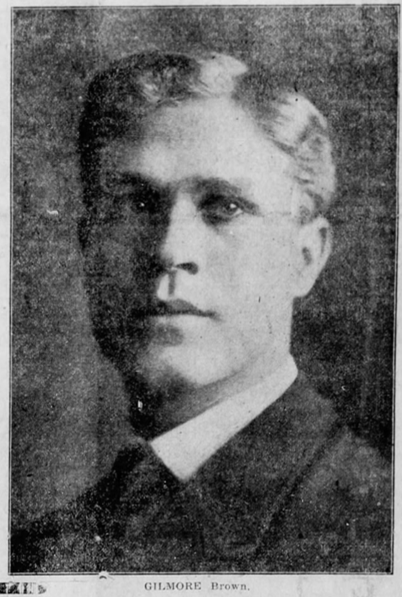
Nevertheless, a misprint in a dissertation found in the Huntington Library led me to uncover this lost story. I would eventually determine that Gilmor Brown, Charlie’s collaborator and close friend, had actively worked to bury it.
This personal drama between the two men escalated from infatuation to partnership, and from there, to rivalry.
The drama between the two men was lasting enough that Gilmor would not forget it a half-century later in his final interviews before his death in 1960. It seems that the Kansas City Star reporters’ fictitious dialogue between the two boys determining “who dreamed” the grand 1912 Midsummer Night’s Dream was prophetic of the historic contention over the event.
In the decades following Charlie’s death, Gilmor went out of his way to ensure the Kinsley festival’s visionary co-founder faded from history. However, the archive that preserved the erasure also preserved enough of a thread to unravel it.
Join us as we continue to trace evidence and uncover both his personal dramas and the collective triumphs Charlie managed: hundreds of people, a fifth of a town, on a make-shift riverbank stage. His journey didn’t stop in western Kansas, but continued to dinners with members of the president’s cabinet, conversations on the periphery of the legendary Algonquin Round Table, and a performance at one of the largest Shakespeare-inspired productions ever to be presented in New York City.


Leave a Reply