

1878
The volatile 1870s economy permitted some merchants on the frontier to succeed, but others suffered persistent disappointment. For those who struggled, Edwards County, Kansas, seemed an attractive locale, geographically far from past challenges to reset, reinvent, and start anew.
This sentiment was everywhere, and it was no coincidence that it had only been a few years since Mark Twain captured the era’s zeitgeist:
The west was more attractive; the further one went the wider the opportunities opened.[i]
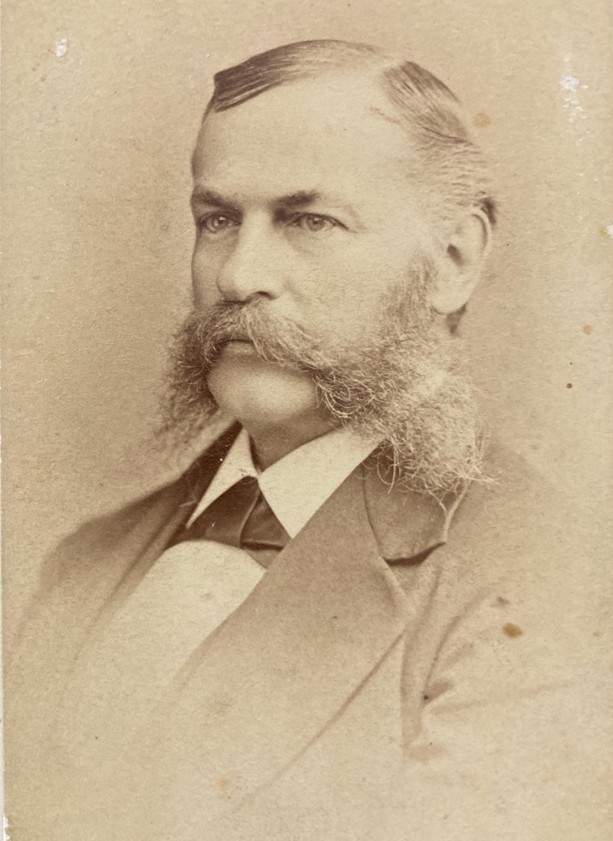
With this idea close to his heart, wire manufacturer Colonel Charles Cadwallader (C. C.) Sellers from Philadelphia considered leaving behind his family’s deep roots and moving west.

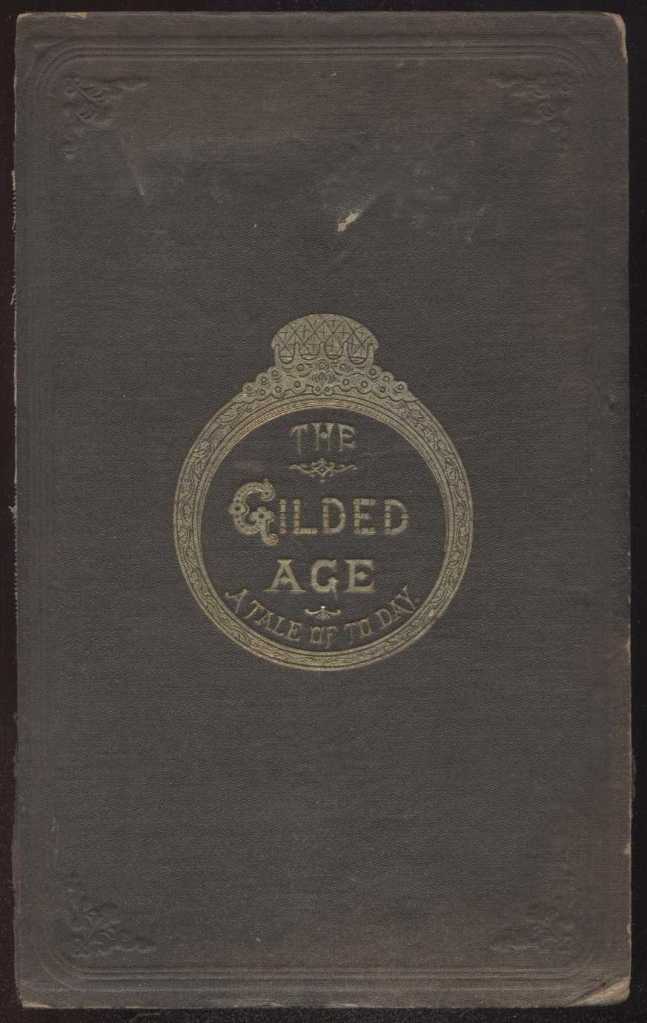
After all, he shared the name Col. Sellers with the famous central character from The Gilded Age. Following a similar westward path to this famous fictional personality seemed almost destined. However, Twain and Warner’s development of the fictional personality could not be called a coincidence; one of C. C.’s cousins inspired the writing duo to an uncanny degree.
However, the Sellers family members were anything but bumbling capitalists, unlike Twain’s fictitious Sellers character. During the Washington presidency throughout the 1790s, C. C. Sellers’ grandfather, David Sellers, and his brother Nathan, designed and manufactured wire screens, which were vital in supporting clients in industries as diverse as agriculture, lumber, gunpowder, and glass. Because of their broad clientele and the importance of their products, the Sellers family played a critical role in developing urban and industrial America, but most specifically in Philadelphia, where their manufacturing enterprises were based.[ii]
Ultimately, the Sellers family had helped build industrial Philadelphia for generations.
Their wire works supplied manufacturers across the growing nation, and several branches of the family became prominent inventors and engineers. The name carried prestige long before Charles Cadwallader Sellers would pack his bags for Kansas.
However, the members of the Sellers family would not only be known for their inventions and business acumen…
When one opened the most popular novel of the 1870s, The Gilded Age, they would discover its ridiculous dreamer, Col. Sellers. For C C Sellers, he learned that the book’s protagonist bore his cousin’s name and was unmistakably based on him.
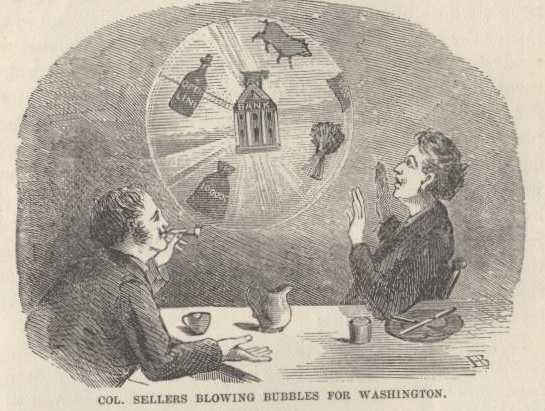
When Escol Sellers, C C Sellers’s second cousin, discovered that Twain and Warner lampooned industrial capitalism through a satirical version of his life as the central character in the Gilded Age, not to mention his name, he was incensed; all of his life’s successes, not to mention his family’s history of building America, had been overwritten with comical failures for the whole nation to read.[v]
Escol hired an attorney and threatened action. Twain recalled the first edition of his novel and changed the first name of the character to “Beriah” in subsequent editions (which would eventually morph into “Mulberry”). Despite a successful and influential career, Escol would never escape the association with The Gilded Age’s central character.[vi]
While Escol loathed the damage the association with Twain’s Colonel had forever exacted upon his image, his second cousin, C. C., seems to have embraced it. No records exist confirming C. C. Sellers attained the legitimate title or rank of Colonel. While he worked as a member of the Home Guard to protect Philadelphia during the Civil War, he never entered active service.[vii] When C. C. ultimately chose to leave Philadelphia behind, the “colonel” embraced not only Twain’s westward-moving ideals of the age but also the moniker inspired by his second cousin. The family wire business, well over eight decades old, that C. C. operated along with two brothers and his brother-in-law, which was recently reorganized after barely surviving the financial ruin of the Panic of 1873, ended in bankruptcy by April 1878.[viii]
In little more than a year, Charles Cadwallader Sellers lost nearly everything.
The family business failed. His forty-three-year-old wife, Rebecca, died. The reputation of generations of Philadelphia manufacturers seemed to collapse with them. If there was ever a moment to begin again, it was now.
Col. C. C. Sellers and his two adult children, twenty-two-year-old Jabez “Jay” and eighteen-year-old Lizzie, had to move forward, leaving behind centuries of family history. Inexpensive land for sale by the Santa Fe Railroad in Edwards County, Kansas, appeared to be the solution. To the colonel, it seemed like a fine place for a fresh start. They were Kinsley-bound.
In the spring of ’78, when the devastating bankruptcy notice appeared in the Philadelphia papers, Col. Sellers and Jay had already purchased a plot of one square mile where they intended to develop an extensive wheat farming operation.[x] The father-son team aspired for five hundred acres of wheat crop by the fall, so they started work immediately. In June, they reported to the Kinsley Republican that they made “numerous improvements” to their farm; as a result, they foresaw “five years hence the Colonel’s homestead will be the attraction of the Upper Valley.”[xi] As a new farmer in Edwards County, Col. Sellers quickly made the acquaintance of Eugene through trade and social events.[xii] Eventually, the newly arrived Philadelphia transplant would sell his pure seed wheat at Edwards’ store.[xiii] Col. Sellers stayed in touch with Eugene, undoubtedly aware that Kinsley’s wealthiest and most influential man was a bachelor. After all, he had a daughter, biding time at home in Philadelphia.
Lizzie delayed her fourteen-hundred-mile adventure west to join her father and brother. Born and raised in one of America’s largest cities to a well-known family, Lizzie lived at the center of America’s growing ambitions. Lizzie Sellers was eighteen years old when her world changed. She had grown up amid the bustle of Philadelphia, one of America’s largest cities, where horse-drawn streetcars clanked down busy avenues and preparations for the nation’s Centennial Exhibition filled the city with excitement. A recent graduate of the prestigious Friends’ Central School, she stood at the center of a country that seemed convinced its greatest days lay ahead.[xiv] Then her father announced they were leaving for western Kansas.
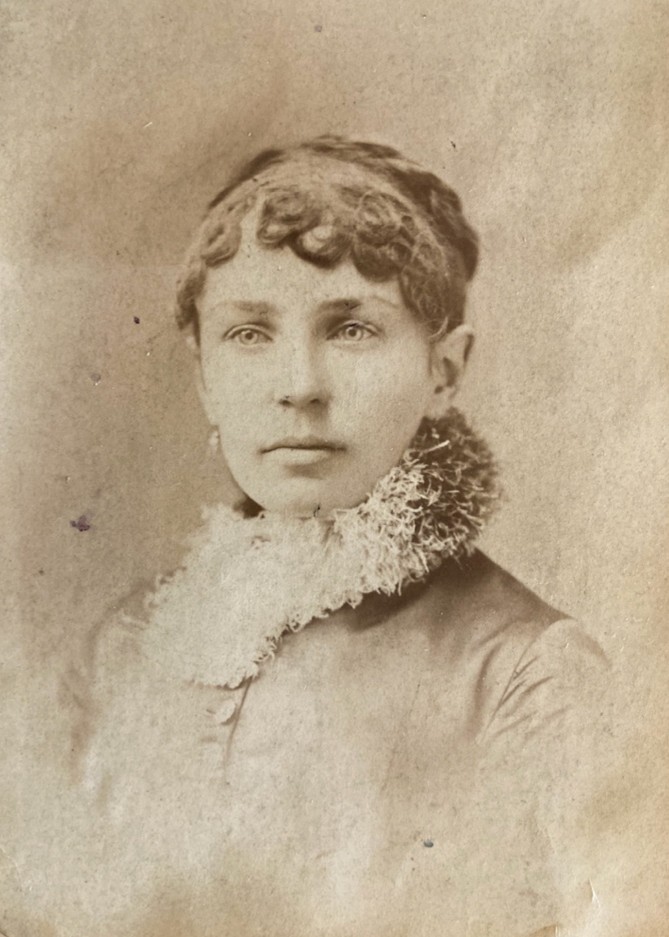
So, she busily and anxiously prepared to remove to a remote frontier town of several hundred people.[xv] Philadelphia had offered concerts, libraries, shops, churches, neighbors, and familiar routines. Kinsley offered daunting possibility, but very little certainty. Fourteen hundred miles away, on the Kansas prairie, a town of only a few hundred residents was still deciding what kind of community it wanted to become. For Lizzie, the journey west meant exchanging one of America’s oldest cities for one of its newest.
This cultural and geographic relocation would have been a considerable adjustment for anyone. So, her delayed arrival on the prairie was likely for her comfort; ultimately, she had little choice in the matter. While she was not moving to a primitive sod-house or dugout, as some farmers with lesser means lived during this time, dangers and complications materialized daily. She knew this going into it, but she could never truly prepare for how radically her life would change.
During the Sellers’ first few months on their land, they, like their neighbors, experienced the persistent menace of horse thieves. With vast miles between outposts and law enforcement a rare luxury, the victims of these criminals often dealt with their perpetrators themselves. Groups of locals would ban together to form posses to defend one another’s animals and property. These parties would perform vigilante law enforcement and their own system of justice. Accounts from Kinsley include horse thieves and other such outlaws hanged on site after being apprehended by a local posse.[xvi] The Sellers and those in their vicinity formed a “vigilants” group so they would not have to “quietly submit to the deliberate depredation of horse thieves.”[xvii] The community took the matter very seriously; within a week, they had assembled an organizational structure and elected Col. Sellers as the chairman and his son Jay as secretary.[xviii] Meanwhile, with what small amounts of available time remained in his schedule, the elder Sellers became active in local politics and organized Republican party primary committees for the fall elections.[xix]
With security measures in place and the farm up and running, Col. Sellers left Jay in charge and returned home to Philadelphia for Lizzie. During this rather expeditious journey, he also retrieved Caroline Lingard, whom he married near Kansas City on the return trip. The new Mr. and Mrs. Sellers, accompanied by their daughter, arrived on their 600-acre plot two days after the on-road marriage.[xx] It seemed that things were finally looking up for the Sellers family.
A few weeks after arriving, another familiar piece of Philadelphia arrived by rail: a new Decker Brothers piano [xxi]. Far more than a household furnishing, this piano indicated an intention: that Kinsley, however distant, would be a place of culture and eventually a place of promise.
Caroline and her stepdaughter Lizzie began to make their new home suitable for entertainment, which Lizzie saw as one of her chief responsibilities even at a young age. Frontier life presented little time for leisure, but still, Kinsley residents shared a desire to replicate their pre-Kansas lives to some degree. While Kinsley’s initial settlers predominantly relocated from the Boston area, as the years progressed, these Massachusetts natives departed, and the population’s origin became heterogeneous.[xxii]
Regardless of their origins, the settlers craved the communal cultural events that reminded them of home. These social expectations included club meetings, literary societies, church groups, music concerts, and even visits from traveling performers. Lizzie, like many of her female contemporaries in Kinsley, leveraged any available time in the pursuit of proving they had equally available offerings as their brethren “back east.” In the 1870s, with a population of approximately four hundred fifty people, this goal was little more than a fantasy.
Lizzie had brought much more than luggage across fourteen hundred miles of prairie. She carried books, music, eastern expectations, and a belief that even a frontier town deserved concerts, literature, and a prolific social life. These things would not come easily, however.
Join us for the next installment of Fairies in the Short Grass, when Theatre formally arrives in the frontier.

 Community Arts Uncovered
Leave a comment